Friday, December 19, 2008

Food Engineering Research at Penn State

I cannot walk by a door with a window and not look inside. And at a research institution like Penn State there are a lot of doors. I was in a hurry so I didn’t have time to do more than make a quick shot and read the sign that indicated I was looking into the Food Engineering Research Lab led by Dr. Greg Ziegler, professor of food science in the Department of Food Science.

Ziegler was in his office and I asked him for a one-sentence description of what work takes place in the lab. He looked at me for a moment and then smiled and told me that one of his graduate students told him that it is frustrating to describe to colleagues what they do because they work across such a broad range. So I wasn’t able to get a short concise answer to my question. And maybe that is the important lesson --- that research is complex and deserves more careful consideration.

I took a look at some of the research publication titles Ziegler has been part of and began to appreciate some of that complexity. Like this one:

Biosynthesis of 1-octen-3-ol and 10-oxo-trans-8-decenoic acid using a crude homogenate of Agaricus bisporus Optimization of the reaction: kinetic factors. Journal of Process Biochemistry.

I’m guessing mushrooms are involved in that work. I found another that I could more easily picture and dealt with something near and dear to my heart- --- chocolate:

Influence of hazelnut paste on the sensory properties and shelf-life of dark chocolate. Journal of Sensory Studies.

Ziegler’s Web site bears out a focus in these areas and describes his research interests as exploring foods as composite materials and an interest in the physical properties and processing of polymeric and particulate foods, with an emphasis on chocolate and confectionery products. One other thing I noticed was his faculty affiliation with the Center for Medieval Studies. Next time I run into him I'll have to explore that.

Chocolate. I wonder if there is chocolate in that lab.

Wednesday, December 3, 2008

Chemical Ecology

Jennifer Dean is a postdoctoral scholar in the Department of Entomology. I photographed her in one of the greenhouses where research is conducted as part of the College’s chemical ecology program. We needed a picture for a late addition to Penn State Agriculture magazine, which will be headed to the printer on Monday. Access to the greenhouse meant passing through a locked door, then a pressurized airlock designed to remove any unwanted insect passengers that might be on our clothes, and finally into the greenhouse. It didn’t take long to make a picture for the magazine, not the one above, but it did take a bit longer as I tried to understand what takes place here.

Dean described her research focus on the chemical ecology of plant-insect interactions, particularly as influenced by below-ground elements such as plant-associated microorganisms and soil nutrients. She’s studying the effects of microbe-induced changes to plant signaling and nutrition on the interactions between herbivores and plants. If you want to read one of her papers you can download Effects of Genetic Modification on Herbivore-Induced Volatiles from Maize.

The machinery in the picture was not set up for an experiment but what you see is a sophisticated vacuum pump which when connected to atmospherically controlled containers is able to pump out the volatile gases given off my plants. Those gases can then be analyzed with a gas chromatograph to study exactly what plants do when attacked by insects. This is a simplistic explanation but remember, I’m a photographer. I’m curious, but no scientist.

I continue to be surprised at the complexity of the science involved in agricultural research. I did a quick scan of some of the courses offered related to chemical ecology. Check out Entomology 539 – Chemical Ecology.

Success in the ag sciences demands a solid foundation in chemistry, biology, and mathmatics.

Monday, December 1, 2008

Winter at Penn State

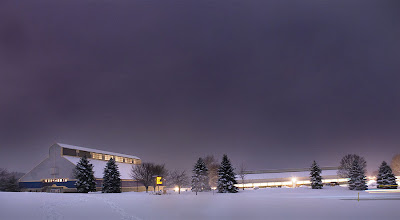
It's the first day of December and my thoughts have turned towards winter.  There has been no significant snowfall yet but it can't be far off now.  I came across this photograph of the Snider Agricultural Arena while searching our digital archive for pictures for a project.  The University Park campus retains a quiet beauty through every season and winter is no different.  As a student years ago I would grumble a bit when I had to walk across campus from East Halls to Deike Building for a Saturday morning class (yes, Saturday morning classes were once a reality).  But I have come to appreciate the changing seasons and the transformation of the campus.  You can see a few more winter campus pictures HERE.

The metadata for this file indicates this picture was made last March at 1:09 AM on Saturday morning.  I don't usually drive back to campus in the snow in the middle of the night but there are times that you just don't want to miss.  And even at this time of night there were people in the Arena and the holding facilities getting ready for an event later that day.  Sometimes it seems the College of Ag Sciences never sleeps.