Friday, July 31, 2009

Water Quality at Penn State

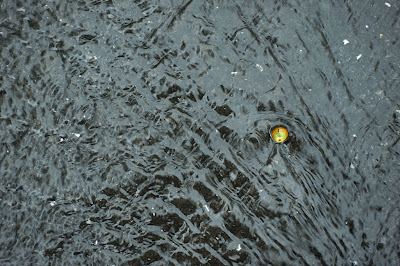
I stopped in the middle of the parking lot behind Ag Administration Building this morning to take a picture of an acorn impeding the flow of water to the Chesapeake Bay. In the next issue of Penn State Agriculture and at Ag Progress Days in a few weeks the College of Ag Sciences will be showcasing the work it does in research and extension to help insure high quality water resources to the people of Pennsylvania and beyond.

The wet week and steady rain this morning kept the umbrellas at the Berkey Creamery down. Clearer weather should arrive at University Park late tonight and into tomorrow.

Another view of campus from earlier in the week of the fountain across the street from the Hetzel Union Building. Rain and shooting between classes can make campus seem like a place of quiet solitude.

Tuesday, July 28, 2009

Doughnut Fueled Science

A different scene from Ag Hill.

When I was a student you had to go downtown to Mister Donut for these. And there were no fresh bagels around. At the Blue Chip Bistro and Cafe in the Business Building (conveniently located on Ag Hill) you can grab one of these in the morning. I've seen a wide range of faculty members, students and researchers there. You have to wonder if a doughnut doesn't hold some secret ingredient to enhance mental acuity....

Seriously though, students have a wide range of choices for food on campus. All part of the Penn State experience. And in case you didn't know it -- if you buy a cup of coffee or tea before 10am you get a doughnut for free.

The Bistro closes at 2pm. It's 1:40. I wonder....

Monday, July 27, 2009

Chemical Ecology and the Hi-Tech Greenhouse

I almost stopped my Vespa in the middle of the road when I saw this shot. I've seen a lot of greenhouses on campus but this one is a startling structure. I was on my way to the Chemical Ecology Lab to photograph Dr. Tom Baker for a story on his recent designation as a Fellow by the Entomological Society of America when I saw the greenhouse. After I photographed Dr. Baker I returned to make this photograph.

A few questions during the shoot with Dr. Baker and I had a bit of information about the greenhouse and what it is used for. And that I couldn't go inside. Plants inside are carefully isolated so that no diseases are present. Researchers and graduate students will infect a plant with a disease and then study the volatile gases given off by the plant when it is stressed. Or when an insect pest is introduced. For instance, if a caterpillar attacks a plant it gives off a specific chemical which signals to caterpillar parasites to pay the plant a visit. Understanding these chemical communications between plants and insects will help build better ways to manage pests and diseases.

The work taking place in this greenhouse is part of the research projects developed by Dr. James H. Tumlinson. Dr. Tumlinson is the Director of the Chemical Ecology Lab and the recipient of the 2008 Wolf Prize for Agriculture.

Wednesday, July 22, 2009

Kids Meet Science

My fascination with blackboards and whiteboards continues. I find the scientific dialogue and collaboration reflected in the words and equations fascinating. At times you can see the thought process of a group of people unfold before your eyes. It occurs in the College of Ag Sciences and across the University Park campus. I expect the same process unfolds at universities and colleges across the planet.

A new element appears in this one. The marks of children. Or a researcher who draws with childlike accuracy. I prefer to imagine a child tagging along with mom or dad, listening to the foreign language floating in the air, sensing the collaboration afoot, and creating their own representation of scientists coming together on a problem.

Then again their drawing could have been their first.

And in case you haven't realized this --- if you click on the pictures you get a larger view.

Tuesday, July 21, 2009

Hort Woods

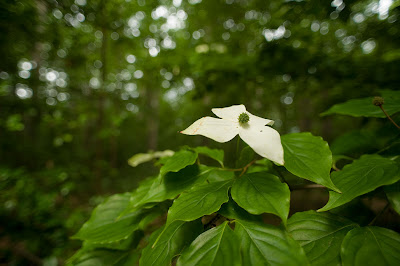
A single dogwood blossom caught my eye on the way across campus this morning. This picture was made in Hort Woods, a small forest remnant on campus pre-dating the existence of Penn State. This small collection of trees and plants sits on prime campus real estate and wonder how it has escaped development. I'm glad it has.

It's easy to miss. I know people who have been at Penn State for decades and don't know about Hort Woods. It's a great place for a stroll at lunchtime.

If you have a minute you should make a visit.

Friday, July 17, 2009

Michael Messina: Director of the School of Forest Resources

Photographed new School of Forest Resources Director Michael Messina this morning for Penn State Agriculture magazine. Messina has been Director for the past six months. The School of Forest Resources is engaged in a wide range of research and outreach activities -- wood products development, forestry, fish and wildlife, recreational landscapes, and other work in diverse forest ecosystems to name just a few.

The school resides in the new Forest Resources Building, one of the newest facilities on campus.


Thursday, July 16, 2009

Buckhout Greenhouses

I have a hard time walking past a greenhouse. Or chocolate. And ice cream.

This picture shows the Buckhout Greenhouses. I didn't have time to go inside to see what the purple flowers were. These greenhouses are now managed by the Biology Department at Penn State but with so much interdisciplinary collaboration facilities across the campus are usually available to scientists and students regardless of their academic homes. The Department of Plant Pathology is in Buckhout Lab and attached to these greenhouses.

While searching for information about the Buckhout Greenhouses I came across a USERS GUIDE. Things are far more complex that they seem.

I also won't pass up a dog who needs a pat on the head.

Wednesday, July 15, 2009

Penn State: The Octatube

At the center of McAllister Building between the HUB and Old Main sits the Octatube. As I understand things the Octatube is a three-dimensional representation of four-dimensional space. For those readers desiring a more detailed description of it I’ll offer the quote below which describes the structure in more detail:

The sculpture, which measures about six feet in every direction, presents the three-dimensional "shadow" of a four-dimensional solid object. "Although mathematicians can work with a fourth dimension abstractly by adding a fourth coordinate to the three that we use to describe a point in space, a fourth spatial dimension is difficult to visualize. The sculpture was designed with a new method which captures four dimensional symmetry better than anything done before.

Adrian Ocneanu, the Penn State professor of mathematics who designed the sculpture.

For those of you really interested in the Octatube click HERE.

McAllister Building is the home to the Department of Mathematics. When I was a student in the early 1970s the place looked quite different. A recent renovation has created an exceptional space for students and faculty. But I digress. There is an agricultural sciences point to this post.

Our students are required to take a variety of mathematics courses and depending on their major or their pursuits of advanced degrees the computational demands rise considerably.

As I work with students and faculty I am constantly amazed at the mathematical sophistication required to pursue the research questions of the day. Computational modeling of root systems utilizing fractal geometry, complex statistical analysis to study and predict disease spread, and much more. That Octatube might look like something from another world but it reflects the continual rise in complexity of scientific pursuits in all disciplines including the agricultural sciences.

Math 61 and 62. The good old days…

Tuesday, July 14, 2009

Penn State and the Urban Side of Green


Faculty, staff and Extension Educators work far beyond the academic boundaries of the campus to help people across Pennsylvania. The work done by researchers filters on to individuals and communities to build better living. Penn State Outreach recently produced a series titled The Urban Side of Green. Part three appears above and describes how agricultural science can help rebuild communities.

If you want to watch the other segments of the series click HERE.

I grew up outside of Pittsburgh and remember what the communities were like before the decline of heavy industry. It's heartening to think that some of that lost spirit can return through projects like these.

Monday, July 13, 2009

Clean, High Quality Water: Bryan Swistock

I made this portrait of Bryan Swistock this morning along Spring Creek for an article in the upcoming issue of Penn State Agriculture magazine. Swistock is an Extension Associate in the School of Forest Resources and works in the water resources area. If there is a question concerning ground water, wells, and a range of other water related questions he is the man. Check out the Cooperative Extension Water Resources Web site. It's where a lot of research findings and experience meet the road to solve problems for people.

I learned something new while making this photo. Bryan pointed out some curly-leaf pondweed, an invasive water plant that he needs for a presentation at this year's Ag Progress Days.

You can download a free PDF factsheet HERE

Photography has its educational perks.

Tuesday, July 7, 2009

The Freshman Seminar

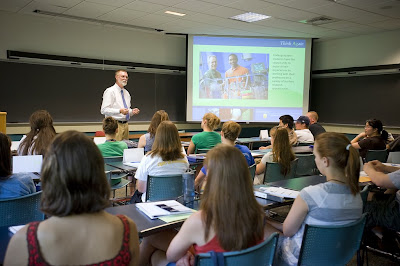
This morning Dean McPheron spoke to the freshman seminar class, AG 150S, about how they might make their time at Penn State more valuable. Cautioning that four years would pass faster than they might expect he stressed the importance of engaging a wide range of possibilities from undergraduate research to study abroad programs.

A variety of faculty and administrators speak during the semester giving students a chance to make connections and learn about opportunities early in their academic careers.

When I was in school there weren't any freshman seminars.

Monday, July 6, 2009

Precision Feeding: Greenhouse Gases and Water Quality

This is the roof of one of the greenhouses used by the Departments of Entomology and Plant Pathology. This view made me think about cows. And greenhouse gases and water quality. Bear with me, it will make sense.

We've been working on a story about precision feeding of dairy cows. One of the goals is to reduce greenhouse gas emissions from cows and better control water quality. Dr. Terry Etherton, Distinguished Professor of Animal Nutrition, gives a great overview of the challenges and opportunities in this area on his blog post titled:


And there is a good description of how precision feeding can help with water quality in a Penn State Live posting called:


Photographs are curious things. They don't always represent what you think they do.

Friday, July 3, 2009

Not Always Sunny in Happy Valley

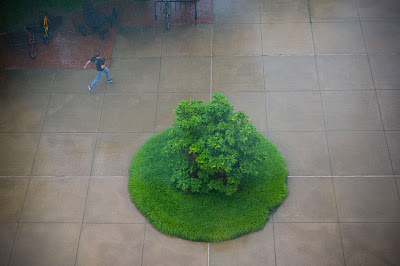
Yesterday after finishing an assignment on the 5th floor of the Agricultural Science and Industries Building I stood at the windows watching the rain from a brief passing storm. I caught this young man racing between the raindrops. I didn't relish pushing a cart full of photo gear back to my office in the rain.

The circular planting outside of ASI Building reminded me of the outstanding landscape that exists at the University Park campus of Penn State. It's easy to take for granted when you are here all the time but every now and again something slows you down and you see it with new eyes. Like the weather.

The College of Ag Sciences offers an undergraduate degree program in Landscape Contracting for those interested in creating spaces like these.

Sometimes it does rain in Happy Valley. I waited five minutes and the sun came out.


Thursday, July 2, 2009

Almost Famous

This morning a copy of the Daily Collegian, our student newspaper, was taped to my office door. My 15 minutes of fame had arrived -- I was on the front page of the paper. The photo above was made outside the Berkey Creamery, my profile gracing the passing public. I'm still waiting to cash in on my celebrity.

The way this unfolded was that I had stopped in front of Tyson Building on Shortlidge Road to photograph a bumble bee on a flower for possible use in our magazine for a short piece on pollinators. As I was shooting I could hear another camera shutter firing.

I zoomed into the wide setting on the lens and adjusted the focus to see a young woman pointing a camera towards me. At first I thought she was making pictures of the flowers but it only took a moment to realize I was the focus of that camera's attention. Unlike most people I don't mind having my picture taken. She told me she was shooting feature art for the Collegian and asked if I would mind having my picture in the paper. I told her it would be fine, gave her my business card and we both went our separate ways.

I worked for the Daily Collegian decades ago and used to do the same kind of thing in the summer. Only then I would have to go back to the darkroom to process the film and make prints. One of the guys who was on the staff the same time I was is Steve McCurry. He shot the iconic cover shot for National Geographic of the young Afghan girl with the bright green eyes. If you are on campus stop by the Palmer Museum. McCurry has a show there right now.

I didn't find a good picture of a bumblebee. The flowers are already in decline and just looked sort of ratty. I'll find another plant still in it's prime.

I wish I had been doing something more heroic on the front page.

Wednesday, July 1, 2009

Dean Bruce A. McPheron

As the clock strikes midnight Dr. Bruce A. McPheron becomes the new Dean of the College of Agricultural Sciences at Penn State succeeding Bob Steele who steps down after 12 years as Dean. I made this portrait in May and was saving it for now. I suspect Dean McPheron will appear in more pictures in the coming weeks and months.

If you are interested in a view of the college and the issues it faces through the eyes of the dean you can follow his thoughts on his blog, Twitter feed, or new Dean's Desk Web site. Make sure to check it out.