Friday, February 27, 2009

Photography in Growth Chambers

As bright as the illumination levels are in a growth chamber it's a challenging environment for photography.  Stacie Bird and I were working on a recruiting project for the horticulture program in the College of Ag Sciences.  Our student model, Kristin, showed great patience as we moved her, lights, camera, etc.  

The chamber is home to some of the plant biotechnology work being done by the Guiltinan Lab.  Recently some of the work on energy conversion of starch was showcased in Penn State Agriculture.

To read the article download the Summer/Fall 2008 issue.

Wednesday, February 18, 2009

Talking about Colony Collapse Disorder

Last year I wrote an article for Penn State Agriculture on Colony Collapse Disorder in honeybees and the research going on at Penn State to help address this crisis. That work continues. One of the people I interviewed, Dennis vanEngelsdorp, works for Penn State's Entomology Department and is the Acting State Apiarist for the Commonwealth of Pennsylvania. vanEngelsdorp is one of those rare experts who not only has passion for his work but can speak plainly and passionately about it as is evident in the video below. 


I found the vanEngelsdorp video by accident while looking at another excellent presentation on TED.com.  TED stands for Technology, Entertainment, and Design and presents the best and brightest from around the world.  It is definitely worth a look and I will start you off with two presentations.

The first is by Elizabeth Gilbert, author of Eat, Pray, Love.  If you have ever wondered why geniuses and creative people are the way they are and not more like the engineers and business people you might know then you need to watch this.

And the second is a talk by Dr. James Watson, co-discoverer of the DNA helix.  Wonder how scientists discover the things they do?  Watch this talk. 

Amazing words from amazing people.  I love working here.

Monday, February 9, 2009

Why Is Research Important: John Tooker

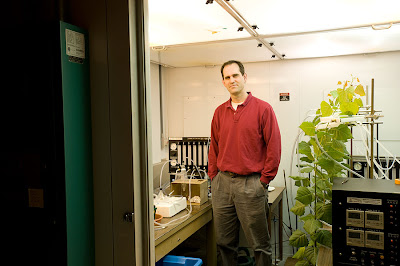
John Tooker, assistant professor of entomology, told me one of the things he is working with is Arabidopsis --- the lab rat of plants. Arabidopsis was the first plant to have its entire genome sequenced and so thoroughly understood in terms of genetic and molecular data that it is a model plant for scientists. If you thought that you might know a plant yourself have a look at ARABIDOPSIS.ORG for an idea of how closely researchers look at a plant. Tooker is working to determine what volatile compounds different mutated versions of the plant give off allowing aphids to differentiate one from another, knowledge that will help develop systems for better plant defense.

I try not to wear out my welcome with questions. I promise I’ll only take a few minutes when I ask someone to be in a picture. My aim is to make quick pictures while moving from one assignment to another.  This picture was made in a growth chamber in the Agricultural Sciences and Industries Building.  Lately I have been thinking about the value of research. Tooker told me what he considered the value of research.

TOOKER: Research allows you to answer unknowns. Questions of how and why and what if. By investing research dollars into universities we are better prepared to solve problems. For instance, I’m interested in how to better control insect problems in crops. If we can discover ways to do that without using as much insecticide, environmental health improves, and the amount of money farmers have to spend on control goes down. As we discover answers and solutions to problems it benefits the public good.

The lab rat of plants. That’s stuck in my head.

Saturday, February 7, 2009

Artists and Scientists

I earned a graduate degree from an art school, seemingly a far cry from the College of Ag Sciences.  But there are similarities at a fundamental level.  Those similarities occurred to me when I saw this lab door in the Entomology Department --- a picture of a woman with an insect in her mouth.  And all those Far Side cartoons by Gary Larson that seem to be stuck up in every lab on campus.  It can't be a coincidence can it?  Far Side comics are so endemic that they affect the scientific community as they did with the naming of the Thagomizer.

If you've wandered the halls, labs, and offices in the college as long as I have you see patterns, one of which is the recurring appearance of posters, cartoons, and comics that wrestle with humorous or absurd ideas relating to science and scientists.  In art school I saw the same patterns in the offices and studios of faculty and graduate students alike.  And I believe those similarities are rooted in some common personality traits.  Curiosity, inquisitiveness, obsession, passion, a desire to know the truth being a few.  Artists and scientists engage in similar actions albeit in much different environments and with very different intent.  But they both are stubborn pursuers of their own interests -- art or science.

I spoke with a retired scientist on Friday at an art opening.  She had paintings on display and when I asked her about it she told me she had an accident that had a profound effect on her brain, the left side, the analytical side.  She was no longer able to perform the calculations necessary to embrace a pursuit of science.  But that fundamental curiosity would not stop and the right side of the brain embraced a different creative path.  Anyone with a creative spirit interested in science might want to look at opportunities at the undergraduate and graduate level in Ag Sciences.

Maybe artists and scientists are more kindred than either care to admit.  Either way they both engage creative spirit to accomplish their goals.

Thursday, February 5, 2009

Distraction and Temptation

I was on my way to the Penn State Horticulture Club meeting last night to see if I could find a few students to be in pictures for some of the Horticulture program's new recruiting materials we are developing.  With the wind blowing, snow flying, and the temperature hovering around 10 degrees the site of the Berkey Creamery sign almost turned me away from my intended route.  The promise of ice cream and getting out of the cold were a serious distraction.  And I know, it doesn't make any sense.

Before I could make my pitch for help at the meeting the club brought in a bunch of pizzas.  Again, temptation tried to push me off course.  I didn't waver though and was happy to find four students volunteer to step in front of the camera in the coming weeks.  Several pictures are on the planning table right now.  One in a research greenhouse, another in a big, walk-in growth chamber, and a couple others in a molecular lab.  I'm looking forward to making these photographs.

After the meeting the weather calmed slightly.  The snow stopped though the cold and wind were still at large.  Spring can't be far off now.

Wednesday, February 4, 2009

Spring Break Class Trip

Barbeque chicken and pork for lunch always draws a crowd. Faculty, staff, and students got together today to raise money for a class trip by selling lunch from Clem’s BBQ. During spring break this year the AG 497B class, a two-credit course, will be heading to Louisiana to engage in service projects in areas still suffering the effects of Hurricane Katrina. Students will be building a greenhouse structure at a New Orleans high school, a living wall at a Baton Rouge high school, and conduct a teacher workshop on building living walls.  All part of the diverse experiences available to students in the College of Ag Sciences.

Lots of people showed up for lunch. I was going to post a picture of mine but I ate it before I thought of the camera…