Wednesday, August 27, 2008

Simple Scene, Complex Science

I was walking to the Berkey Creamery the other day and could see a chaotic intertwining of sorghum plants with paper bags over the plant flower heads inside one of the Crop and Soil Sciences greenhouses. I liked the way they looked. I took a picture. But as always my curiosity gets the best of me.

I knew that some sort of breeding experiment had taken place and at the end of the season now these plants were about to be removed to make way for a new experiment. Checking the tag on the door indicated that this work was being done as part of the agricultural research of Dr. Surinder Chopra, Associate Professor of Maize Genetics in the College of Agricultural Sciences at Penn State.

Back at my office a quick email exchange with Dr. Chopra revealed the title of the research project of which these corn plants were a part:

Flavonoids Phytoalexins in Sorghum-Colletotrichum interaction

Dr. Surinder was kind enough to provide some additional information and with a little thought I was able to understand a little of what was happening.

Phytoalexins are low molecular weight compounds synthesized by plants during biotic and abiotic stress. Biotic stressors could be things like insects and diseases. Abiotic stressors would be non-living elements of an ecosystem—drought, heat, and cold for example.

Dr. Chopra is interested in understanding the genetic pathway of biosynthesis of these compounds when plants are stressed. These compounds help make plants more resistant. The research also involves transferring resistance from sorghum to maize.

The science of this work is far beyond my passing interest in the visual aspects of the work. But it is easy to see how important it is in a world where demand for food continues to grow and biotic and abiotic stress grows as well.

I’m always amazed at how serious the back story is to many of the seemingly innocuous scenes I run across. I never did get to the Berkey Creamery that day.

Wednesday, August 13, 2008

Ag Hill at Night

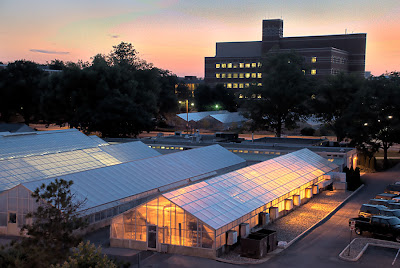
I made this view towards the Agricultural Sciences and Industry Building (ASI) last night. There are a lot of pretty views of Ag Hill from the top of the Eisenhower Parking deck. On some evenings all the greenhouses are illuminated. Not the case today though. Projects are in transition right now and some don’t need the extra light I suppose.

The University Park campus of Penn State is a beautiful place. At night is can look magical. I need to get out more after dark. I’ll search for some more interesting views of the College of Agricultural Sciences at night.

ASI is one of the bigger buildings on campus and houses the departments of Entomology and Crop and Soil Sciences. There are also labs and offices for faculty and staff in the Department of Dairy and Animal Science as well as classrooms, meeting rooms, a small cafĂ© and a lot of other things. And at this time of the evening it’s still pretty busy with graduate students working on a wide range of projects into the wee hours.

Friday, August 8, 2008

Spend a Summer Day

Every summer the College of Agricultural Sciences takes part in Penn State's Spend a Summer Day program. This event gives prospective students and their families a chance to visit campus and explore what the university has to offer in a focused manner. All the academic programs are represented in one place making it possible for students to ask questions and figure out what their best path might be.

While visitors were in the auditorium in the new Forestry Building learning more about the College of Ag Sciences some of the participating faculty and staff were waiting outside. I made a picture because I was struck by the arrangement of figures in front of me reminiscent of a Bottecelli painting.  

Agricultural science embodies a wide range of thought---from genomics to food security and even to Bottecelli.  It's amazing what comes along...