Friday, June 27, 2008

Kids, Cameras, and Ag Progress Days

If you work in our College and either my assistant or I discover you have children we will eventually knock on your door. “Do you think it might be possible that we could use your kids as models in a picture for…”. I’ve uttered these words many times. And you can track the growing up of my daughter from infancy into her early teens in a range of College of Agricultural Sciences publications.
 
On this particular morning we were making a photograph of the kids playing with handmade wooden models of buildings that one might see in towns and farms across Pennsylvania. The image will be used to promote an educational, hands-on workshop for kids at this year’s Ag Progress Days. The wooden models will help them explore the basic principles of land use.

Working with kids is tough work. They make crawling around on a concrete floor look easy but my body tells me otherwise. I’m not a kid anymore despite what I think.

Monday, June 23, 2008

Grassland Bird Population Decline

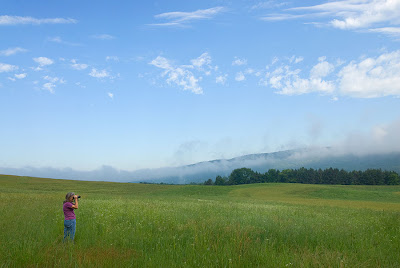
Dr. Margaret Brittingham is a professor of wildlife resources in the School of Forest Resources in Penn State’s College of Agricultural Sciences. When I shot this picture yesterday morning she was tracking an Eastern Meadowlark across the sweep of pasture. A quick look at Dr. Brittingham’s research interests and professional affiliations reveals a passion for birds. She’s currently studying the decline in grassland species of birds in Pennsylvania and was excited to see a Meadowlark. Letting grass grow this long into the season helps allow the birds to hatch and get out of the way before haymaking.

We were at this location not for birds but to shoot a cover photograph for an Extension publication on farmlands and wildlife. Watching the birds at the feeder at home I get excited to see a Carolina Wren or Black-capped Chickadee. On this trip I was introduced to a Yellow-Billed Cuckoo, a Bobolink, and the Eastern Meadowlark. One of the fringe benefits of being a photographer in a research institution is the constant on the job education available in a wide range of areas.  Ag Research is far ranging at Penn State.

I forgot how wet you can get walking through tall grass in the morning.

Friday, June 20, 2008

Bioreactors and Biofuels Research

While working on illustrations for an article in the next issue of Penn State Agriculture magazine I found myself in a lab fuel of bioreactor vessels. This lab runs under a collaboration between Penn State’s College of Agricultural Sciences, Engineering, and Earth and Mineral Sciences. Work here will look at techniques and processes of extracting energy from a range of feedstock from soybeans and corn to switchgrass and other lignocellulosic-based materials.  Much of this research is done by researchers working with Penn State's Institutes of Energy and the Environment.

For me these devices were small sculptures and quite inviting as subject matter.  Stay tuned for the next issue of the magazine to see if anything makes it’s way onto those pages.

Thursday, June 5, 2008

Ag Research: Corpus Luteum

I documented the processing of a corpus luteum (CL), the structure that forms on the ovaries of mammals after ovulation. The CL plays a critical role in establishing and sustaining pregnancy. Researchers work to separate and isolate cell types using a variety of techniques including spinning material at high speeds with a centrifuge. The layers in the tube dramatically visualize some of the early cell and tissue separation. A more extensive discussion of this work and of Penn State’s Center for Reproductive Biology and Health will appear in the next issue of Penn State Agriculture magazine.

Ag researchers patiently explain their experiments but often (usually) the science is far beyond my comprehension. The science and technology applied in agriculture is as sophisticated as any area of research. A flow cytometer using a laser to count individual cells passing through a near microscopic column was just one of the devices in use during my assignment today involving reproductive biology.