Wednesday, April 30, 2008

Equations, Mathematics, and Science in Agriculture

I’m attracted to the secret languages that appear on chalkboards and whiteboards throughout the College of Agricultural Sciences. As agriculture becomes more complex so do the equations, formulas and expressions appearing in labs and classrooms.

It took a phone call to Dr. Edward Dudley in the Food Science department to unravel the meaning in the above photo. Dudley said he was explaining to a graduate student how to deactivate a gene in E. coli bacteria. Micro- and molecular biology play an important role in assuring safe food and Dudley researches pathogenesis, mechanisms of environmental survival, and genetic diversity of E. coli organisms using molecular biology approaches.

I thought scientists only wrote complicated equations and expressions on chalkboards in movies. There is a reason why there are so many boards around in labs and classrooms. It’s still a forum for dynamic teaching and learning.

Friday, April 25, 2008

Biological Control of the Human Disease Bilharzia

At first glance it just looked like a fish tank. A graduate student told me these fish were cichlids from Africa and South America. The pale guy at the lower left is a baby. I was in the building to retrieve a piece of lighting gear I left behind in one of the wood chemistry labs but couldn't resist a quick shot of these fish. And a little research when I got back to my office explained how they fit into agricultural research.

The lab belongs to Dr. Jay R. Stauffer, Jr., Distinguished Professor of Ichthyology in the College of Agricultural Sciences at Penn State. He and his research group have studied the effects and influences fish have on ecosystems in the Susquehanna, Potomac, and Allegheny Rivers as well as those in places like Lake Malawi.

That's where the cichlids come in. These fish in the lab tank are for show. The real study takes place in the waters of Lake Malawi. It's complicated but let's just say Stauffer is studying the role cichlids have in the control of Bilharzia, an infectious disease caused by a parasite that gets out of control when the fish population declines. You can read more about it HERE. Bilharzia is a disease that adversely affects some 200 million people in the tropical regions of the world.

Those fish look a little different to me now.

Monday, April 21, 2008

Penn State Horses

It’s not often you see horses walking on campus anymore. Especially just a few hundred yards from Beaver Stadium on the day of the Blue-White football game. 

These are some of Penn State’s Registered Quarter Horses on their way to the Little International, a livestock show run by the Block and Bridle Club. All these horses, two year olds and yearlings, were part of the judging competition that takes place every spring. And if you are in the market for a good Quarter Horse some of them will be available at this coming weekend’s Registered Quarter Horse Sale.

The Penn State Dairy Expo also took place at the Ag Arena with students from the Dairy Science Club showcasing their skills in preparing and exhibiting dairy cattle. Lots of animals to look at on Saturday – horses, sheep, swine, beef cattle, and Holstein cows.

Friday, April 18, 2008

Landscape Contracting

At this time of year junior and seniors in the Landscape Contracting program bring to life landscaping projects worked on in their design studios. From site drawings, models, and CAD designs they have the opportunity to see what an idea will look like in a real installation. It seems a wonderful opportunity to merge art, technology, and natural systems. I caught this scene as a group of students walked out of the frame and left Gabe appearing to be all my himself amidst a large project.

This installation is taking place next to the Carnegie Building, a place with a lot of history at Penn State. A gift by steel magnate and Penn State trustee Andrew Carnegie it has at one time housed the Library, the Daily Collegian – one of the nation’s first daily college newspapers, and now home to the College of Communications. But for landscape contracting students its now a big canvas to practice what they learn.

Wednesday, April 16, 2008

Zen Art

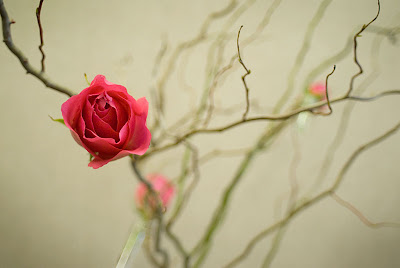
Returning from an assignment yesterday morning I noticed a new arrangement of flowers in the lobby. Each week this semester a Horticulture student has been delivering a new work of art. I was struck by the strong resemblance to Japanese Zen painting and had to pause to make a picture. In a few weeks the student will graduate but I hope another will continue to share their interpretations.

Monday, April 14, 2008

Spring Beginnings

Theoretical Agriculture is a place where I’ll post things that attract my attention as a photographer working in the College of Agricultural Sciences at Penn State. Over the coming weeks you'll glimpse what I see behind the scenes.

It seemed appropriate to begin with a sign of spring -- flowers (though research greenhouses offer blooms year round). I found these Regal Pelargoniums while searching for a location to shoot an assignment, a routine that gives me a chance to notice little landscapes like this.

These plants are part of a breeding program in the Department of Horticulture focused on improving their commercial performance. Things like color, and better resistance to insects and disease.

It’s a beginning.